High-Density Compound Balanced Weave Conveyor Belts: Precision Metal Mesh
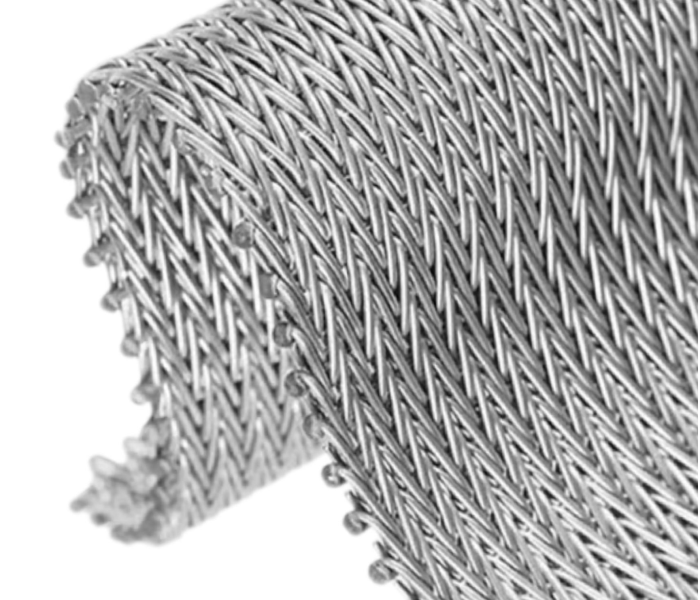
The mesh of compound balanced weave conveyor belts are very closed, so these belts are used in those application which include carrying of very small parts, such as nuts bolts, screws, nails etc.
Compound weave conveyor belt supplies extremely close and flat mesh. This is made of stainless steel and high carbon steel. They all have excellent high temperature resistance performance and high tensile strength. All these metals ensure the Compound weave conveyor belt to be a strong, durable and high lifespan product. It is also known as Cord Weave Belt. The structure of Compound weave conveyor belt is similar to the balanced weave conveyor belt, which has multiple spirals and cross rods per pitch. The compound weave conveyor belt has closer mesh than the balanced conveyor belt. The closer mesh makes compound weave conveyor belt a high density and high strength surface
What is a Compound Balanced Weave Conveyor Belt?
Compound Balanced Weave Conveyor Belts, often referred to in the industry as Cordweave or CB series belts, represent the pinnacle of high-density metal mesh engineering. Unlike standard weave patterns, the compound design utilizes a nested structure where multiple spirals and cross-rods are interconnected to create a smooth, dense, and remarkably flat carrying surface.
This intricate architecture is specifically designed for industries where product stability is non-negotiable. Because the “apertures” or holes in the mesh are virtually non-existent, these belts act more like a continuous solid sheet of metal while maintaining the flexibility and tracking benefits of a woven belt.
Core Engineering: Anatomy of the Compound Mesh
Technical Specifications and Material Composition
To ensure longevity in harsh environments, these belts are manufactured from various high-grade alloys. Selecting the right material is critical for balancing tensile strength and thermal expansion.
- T-304 Stainless Steel: The standard for food-grade applications and general corrosion resistance.
- T-316 Stainless Steel: Enhanced resistance to acids and chlorides.
- High-Carbon Steel: Ideal for high-friction industrial environments without corrosive exposure.
- Specialty Alloys: Chrome-moly and nickel-chrome steels for temperatures exceeding 1000°C.
The Nested Spiral Geometry
The “Compound” in the name refers to the multiple spirals per cross-rod (often designated as CB3, CB4, or CB5). By nesting these spirals closely together, the belt achieves:
- Superior Flatness: Minimizing product tipping or vibration.
- High Tensile Strength: Distributing the load across more points of contact.
- Low Stretch: Reducing the need for frequent tension adjustments.
Why Choose Compound Balanced Weaves?
- Small Part Retention
If you are conveying tiny components—such as needle bearings, bolts, or delicate snack foods—standard weaves allow for “fall-through.” The closed-mesh structure of the compound weave ensures 100% product retention.
- Uniform Heat Distribution
In baking or heat-treating kilns, consistent airflow is vital. While the mesh is dense, the micro-porosity of the compound weave allows for uniform thermal transfer across the entire width of the belt, preventing “cold spots” in your production line.
- Stability Under Heavy Loads
The dense interconnection of wires provides a high strength-to-weight ratio. This makes it the preferred choice for heavy-duty industrial furnaces where heavy metal parts must be moved through high-temperature zones without the belt sagging or deforming.
Primary Industrial Applications
Food Processing and Industrial Baking
From crackers and biscuits to granola and small snack pellets, the compound balanced weave provides the smooth surface required to prevent dough indentation while ensuring the product releases cleanly after baking.
Heat Treating and Sintering
In metallurgy, parts must often be subjected to extreme heat. The CB5 weave is frequently used in brazing furnaces and sintering lines because it can withstand the thermal cycling without losing its tracking integrity.
Electronics and Small Parts Manufacturing
The flat surface is ideal for conveying electronic components through curing ovens or wash cycles where stability is paramount to prevent damage to sensitive pins or casings.
Installation and Maintenance Optimization
Drive Systems: Friction vs. Sprocket
Most compound balanced belts are friction-driven, relying on large diameter rollers to maintain traction. However, for precise timing, side chains can be integrated to ensure synchronous movement.
Cleaning Protocols
Due to the density of the mesh, cleaning requires high-pressure air or steam systems. In food applications, ultrasonic cleaning baths are often utilized to ensure no organic material remains trapped within the nested spirals.
Features of Compound Weave Conveyor Belt:
- a) Small open area
The compound weave conveyor belt has little open area, which is suitable to conveyor the small items.
b) High tensile strength
The compound weave conveyor belt has multiple spirals and cross rods on each pitch, so it can supply higher tensile strength than other types of conveyor belt.
c) High temperature resistance
The compound weave conveyor belt is made of high quality materials, including stainless steel and nickel alloy steel, which have excellent temperature resistance performance.
d) Durable and long service life
The unique structure and high quality material can ensure the long service life of compound conveyor belt.
e) Baffles
Different types of baffles can be added at the both side and center of conveyor belt for sorting and conveying products.
Applications of compound weave conveyor belt:
The compound weave conveyor belt with little open area is popular in the food, electric, mechanical and other industries. It can be used to convey the following products:
• Baking biscuit • Nuts • Bolts • Cookie • Particles
Specifications | Mesh Size | No. of Rods | Spiral Wire Dia. | Cross Wire Dia. |
EWM 4-28-19-16 | 2.5 | 4 | 1.60 | 1.60 |
EWM 3-60-132-19 | 5 | 3 | 1.00 | 1.00 |
EWM 3-30-71-14 | 2.5 | 3 | 2.0 | 2.0 |
EWM 3-35-62-14-12 | 3 | 3 | 2.0 | 2.60 |
EWM 3-35-54-12-11 | 3 | 3 | 2.0 | 3.00 |