Choosing the Right Wire Mesh Material & Grade for Superior Strength, Durability & Performance
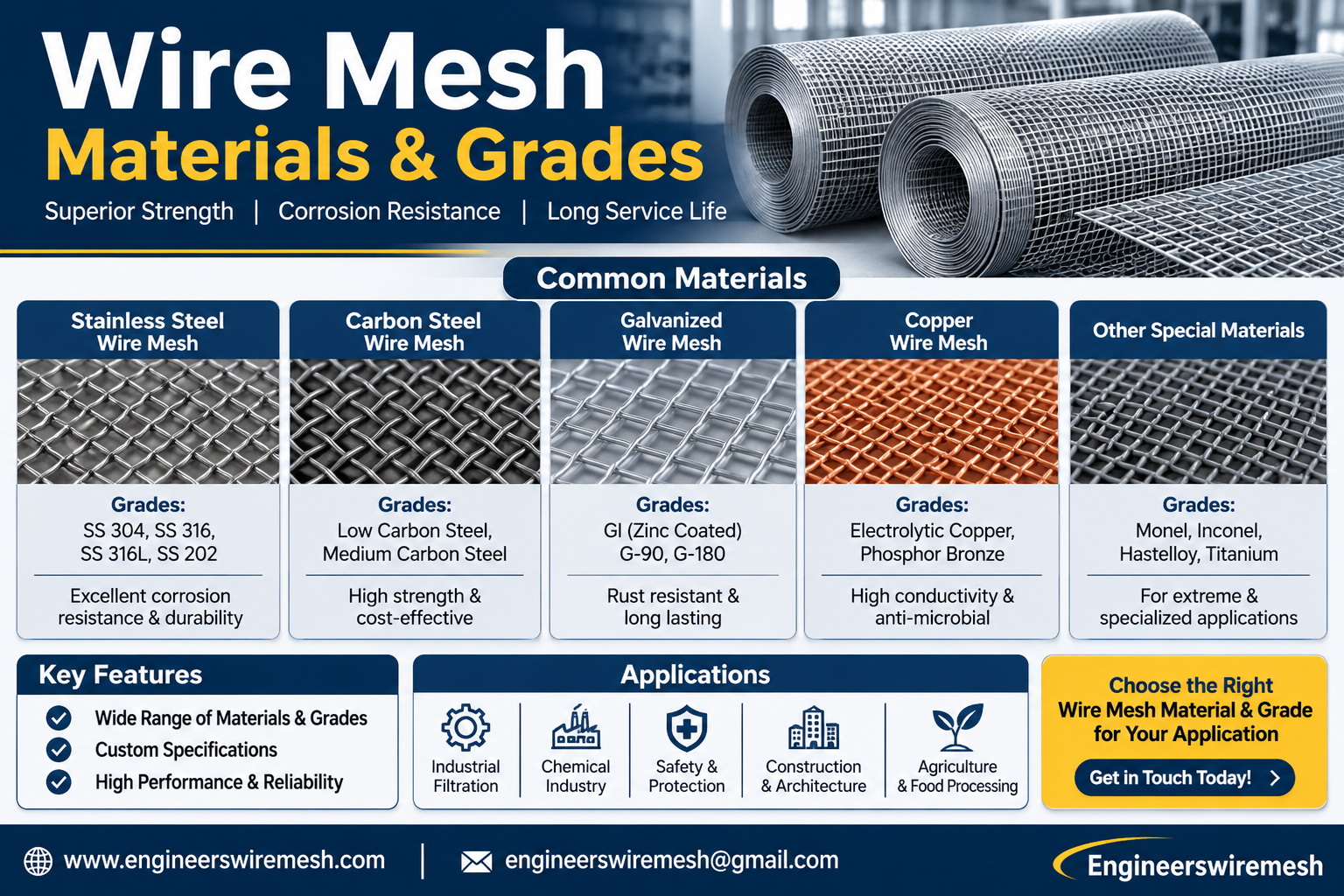
Selecting the right wire mesh material and grade is essential for ensuring durability, corrosion resistance, mechanical strength, and reliable performance in industrial applications. Wire mesh is manufactured using different metals and alloys, depending on operating conditions, temperature, chemical exposure, load requirements, and end-use applications.
1. Common Wire Mesh Materials & Grades
Material | Common Grades / Specifications | Key Properties |
|---|---|---|
Stainless Steel | SS 304, 304L, 316, 316L, 310, 310S, 430 | Corrosion resistance, strength and durability |
Mild Steel | AISI 1005, 1006, 1008, 1010, 1018 | Economical, weldable and easy to fabricate |
Carbon Steel | Low Carbon, Medium Carbon, High Carbon Steel | Strength, hardness and wear resistance |
Galvanized Steel | Electro-Galvanized, Hot-Dip Galvanized | Zinc-coated corrosion protection |
Aluminium | 5052, 5154, 6061 and other suitable alloys | Lightweight and corrosion resistance |
Copper | Commercial Copper Grades | Electrical and thermal conductivity |
Brass | C260, C270, C280 and other suitable alloys | Conductivity, appearance and filtration |
Bronze | C220, Phosphor Bronze | Wear resistance and corrosion resistance |
Nickel Alloys | Nickel 200, Monel 400 | Corrosion resistance in specialised environments |
Special Alloys | Inconel, Hastelloy, Titanium, Duplex Steel | Specialised chemical and temperature resistance |
Material availability and suitability depend on the wire mesh manufacturing process and application.
2. Stainless Steel Wire Mesh Grades
Grade | Characteristics | Typical Applications |
|---|---|---|
SS 304 | General-purpose corrosion resistance | Industrial filters, screens and food processing equipment |
SS 304L | Low-carbon version of 304, suitable for welded fabrication | Welded mesh and fabricated components |
SS 316 | Improved resistance to chloride-related corrosion | Marine, chemical and pharmaceutical applications |
SS 316L | Low-carbon version of 316 | Chemical processing and welded filter assemblies |
SS 310 / 310S | High-temperature resistance | Industrial furnaces and heat-treatment equipment |
SS 430 | Ferritic stainless steel | Architectural and general-purpose screening |
SS 304 vs SS 316: Grade 304 is a widely used general-purpose stainless steel, while Grade 316 contains molybdenum and offers improved resistance to pitting corrosion in many chloride-containing environments.
3. Material Selection Based on Application
Industry / Application | Recommended Material |
|---|---|
Food Processing | SS 304 / SS 316 |
Pharmaceutical Industry | SS 316L / SS 304 |
Chemical Processing | SS 316L / Special Alloys |
Mining & Mineral Screening | High Carbon Steel / SS 304 |
Automotive Industry | SS 304 / Mild Steel |
Architectural Applications | SS 304 / Aluminium / Brass |
Conveyor Belts | SS 304 / SS 316 / High-Temperature Alloys |
Agricultural Applications | Galvanized Steel / Mild Steel |
Marine Applications | SS 316 / Suitable Nickel Alloys |
High-Temperature Applications | SS 310S / Inconel |
Final grade selection should be based on actual chemical exposure, temperature, mechanical loading and operating conditions.
4. Important Factors for Selecting Wire Mesh Materials
Corrosion Resistance: Select suitable materials for moisture, chemicals, saltwater and outdoor exposure.
Temperature Resistance: Consider maximum operating temperature and thermal cycling.
Mechanical Strength: Evaluate tensile strength, load capacity and wear resistance.
Mesh Specifications: Consider wire diameter, aperture size, mesh count and weaving pattern.
Surface Finish: Choose suitable finishes, such as bright, polished, annealed, galvanized or coated.
Manufacturing Requirements: Consider welding, weaving, crimping, forming and fabrication requirements.
5. Material Certification & Quality Standards
For industrial procurement, wire mesh specifications should clearly identify:
Material grade and applicable material standard.
Chemical composition and mechanical properties.
Wire diameter and aperture tolerances.
Surface finish and coating specifications.
Mill Test Certificate (MTC), where required.
Inspection and quality assurance requirements.
6. Custom Wire Mesh Manufacturing
Wire mesh can be manufactured in different materials, grades, wire diameters, mesh openings and configurations to meet specific industrial requirements.
Available product configurations:
Woven Wire Mesh
Welded Wire Mesh
Crimped Wire Mesh
Stainless Steel Wire Mesh
Conveyor Belt Mesh
Filter Mesh
Perforated Metal Sheets
Expanded Metal Mesh