Wire Mesh Belts for Furnaces: Choosing the Right SS310 and SS314 Stainless Steel Conveyor
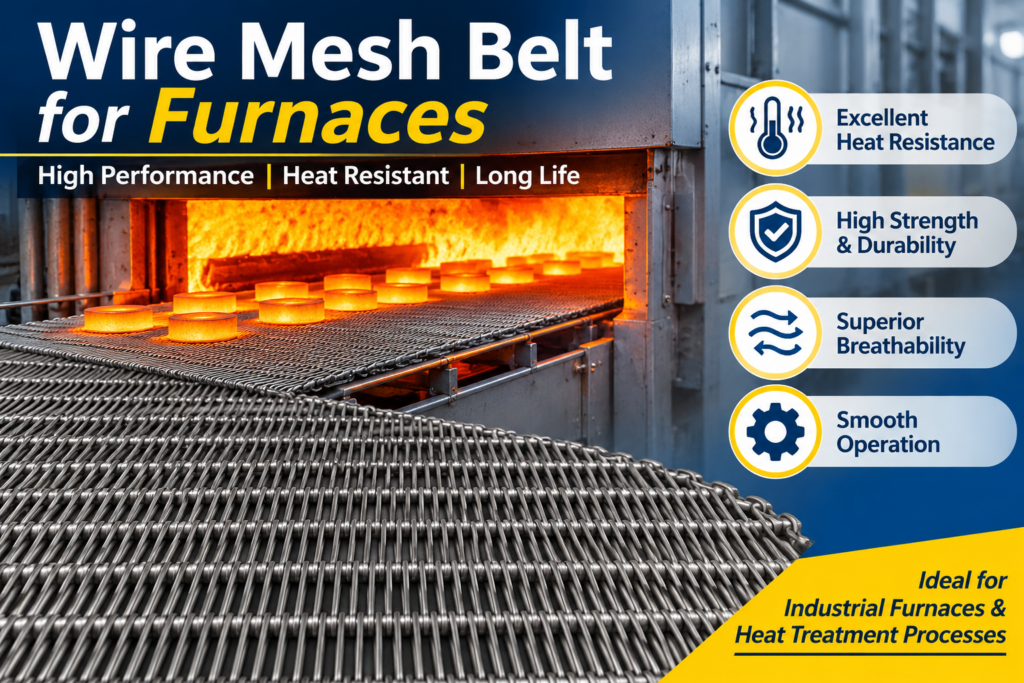
If you run a furnace line, you already know the conveyor belt is one of the hardest-working parts of the system. It carries product through heat that would quickly ruin ordinary steel, cycles between hot and cool zones, and often does it for thousands of hours. Choosing the wrong belt shows up as stretching, tracking problems, scale, broken wires, and unplanned downtime.
This guide covers what wire mesh belts for furnaces are, how SS310 and SS314 stainless steel differ in practice, and which factors to weigh before you request a quote.
What Are Wire Mesh Belts for Furnaces?
A wire mesh belt is a conveyor belt built from metal wire woven or linked into a flexible, continuous surface. In a furnace, it carries parts or material through heating, soaking, and cooling zones without a separate carrier or tray.
Compared with solid belts or cast links, a mesh belt is open and relatively lightweight. That openness lets heat and process gas reach the load from several directions, and it lets debris, scale, and quench media fall through.
Where they are used in furnace processing
A heat-resistant conveyor belt of this kind is common in:
- Brazing and sintering furnaces, for metal parts and powder-metal components
- Annealing and stress-relieving lines, for small metal parts, wire products, and fasteners
- Heat treating furnaces, such as hardening and tempering lines for small and mid-size components
- Glass and ceramic processing, such as lehrs and firing or decorating lines
- Baking, drying, and curing ovens, where temperatures are lower but cleanliness matters
- Electronic component and powder processing, where controlled atmospheres are common
Requirements vary widely between these uses, which is why a “one-size-fits-all” furnace belt rarely exists.
Why Material Choice Matters at High Temperature
A high temperature furnace mesh belt faces several problems at once:
- Oxidation and scaling. At high temperature, the wire surface reacts with oxygen. The belt needs an alloy that forms a stable, adherent oxide layer rather than flaking away.
- Loss of strength. Steel gets weaker as it heats, so belts can slowly deform or “creep” under load and tension.
- Thermal cycling. Repeated heating and cooling causes expansion, contraction, and fatigue.
- Atmosphere effects. Carbon, nitrogen, sulfur, and moisture in the furnace can attack some alloys.
Standard grades such as 304 or 316 work well in moderate heat. As temperatures climb, belt makers usually move to higher-chromium, higher-nickel grades. SS310 and SS314 are two of the most common choices.
SS310 vs. SS314: A Practical Comparison
Both are austenitic stainless steels with roughly 24–26% chromium and 19–22% nickel. These are nominal ranges, so check the exact composition on the material certificate. That chromium and nickel content gives both grades strong oxidation resistance at temperatures where 304 and 316 would degrade.
The main difference is silicon. SS314 contains noticeably more silicon than SS310, and that changes how it behaves in some atmospheres.
SS310 stainless steel
SS310 (and its low-carbon variant, 310S) is the more widely available of the two. It is a common choice for:
- Continuous high-temperature service in oxidizing atmospheres
- General annealing, brazing, and heat-treating lines
- Applications with moderate thermal cycling
Its high chromium and nickel content gives good scale resistance. The alloy itself is often cited as suitable for continuous service in air up to roughly 1,100°C. Treat that as an alloy-level reference, not a belt rating (more on that below).
SS314 stainless steel
SS314 adds extra silicon, which improves resistance to scaling and, in many cases, to carburizing conditions. It is sometimes chosen when:
- Temperatures are at the top of the stainless range
- The atmosphere has a carburizing tendency
- Thermal cycling is frequent and scale adhesion matters
Availability can be more limited than SS310. Wire stock, lead times, and cost may differ, so confirm with the manufacturer early.
Side-by-side summary
| Factor | SS310 | SS314 |
|---|---|---|
| Typical chromium / nickel | ~24–26% / ~19–22% | ~23–26% / ~19–22% |
| Silicon content | Low | Higher (about 1.5–3%) |
| Oxidation resistance | Very good | Very good, often slightly better scale resistance |
| Carburizing atmospheres | Moderate | Generally better |
| Availability | Widely stocked | More limited |
| Typical use | General high-temperature furnace belts | More demanding scaling or carburizing conditions |
A few cautions for both grades
- Sigma-phase embrittlement. After long exposure in roughly the 650–900°C range, both grades can become brittle, and higher silicon can encourage it. If your belt lingers or cycles through that range, discuss it with the supplier.
- Sulfur-bearing atmospheres. Nickel-containing alloys can suffer in reducing, sulfur-containing conditions.
- Heavy carburizing or nitriding. Neither grade is the best answer in every case. Some processes call for higher-nickel alloys instead.
Key Selection Factors
A premium stainless steel wire mesh belt for a furnace is only “premium” if it fits your process. Work through these factors in order.Lorem ipsum dolor sit amet, consectetur adipiscing elit. Ut elit tellus, luctus nec ullamcorper mattis, pulvinar dapibus leo.
1. Operating temperature
Start with your real peak and continuous temperatures, including hot spots. The alloy’s oxidation limit is not the same as the belt’s safe working temperature. A loaded belt under tension loses strength well before the metal starts scaling badly, so belts are generally run below the alloy’s maximum. Give your manufacturer the true process temperature, not a rounded number.
2. Load weight and distribution
Ask:
- What is the product weight per unit area?
- Is the load evenly spread or concentrated?
- Are parts sharp, rough, or heavy enough to damage wire?
Heavier loads typically call for thicker wire, a sturdier weave, or a different belt style.
3. Furnace atmosphere
Be specific about what is in the furnace: air, nitrogen, hydrogen, endothermic gas, vacuum, or something else. Mention moisture, carbon potential, and any sulfur sources. Atmosphere is often what separates an SS310 choice from an SS314 or another alloy.
4. Belt speed and cycle time
Speed affects how long each section of belt spends in each zone and how fast it cycles through heating and cooling. Faster or more frequent cycling raises fatigue demands. Slow belts spend longer at temperature, which matters for creep and oxidation.
5. Mesh design and weave
The mesh weave controls support, flexibility, open area, and strength. Common styles include:
- Balanced weave, with a flat, stable surface for general use
- Compound balanced weave, which is denser and supports small parts
- Spiral or flat-flex styles, which are open and flexible
- Ladder or eye-link styles, for heavier or specialized duty
Tighter weaves support small parts and give a smoother surface, but they restrict airflow and add weight. Open weaves help circulation and drainage but may not support small items.
6. Wire diameter
Thicker wire carries more load and tolerates more wear, but it adds thermal mass and weight. That can slow heat-up and put more stress on drive systems. Thinner wire is lighter and more responsive but wears out sooner under heavy loads. Match the wire to the load and the expected life, not to the thickest option available.
7. Edge finish and drive system
Check how the belt is driven (friction, sprocket, or chain edge) and how the edges are finished (welded, looped, or with side chains). Poor edge design is a frequent cause of tracking trouble and early failure.
8. Maintenance and inspection
A belt that is easy to clean, inspect, and repair costs less over its life. Consider:
- How easily scale and debris can be removed
- How the belt can be spliced or repaired
- Whether you can monitor elongation and tracking
- How much downtime a replacement takes
Practical Buying Tips
Before you contact wire mesh belt for furnace manufacturers, gather this information:
- Maximum and normal operating temperatures, and how long the belt stays at each
- Furnace atmosphere and any contaminants
- Product type, weight, size, and how it is loaded
- Belt width, length, and furnace geometry
- Belt speed and cycle pattern
- Drive and support method
- Current belt failures (stretching, cracking, scaling, tracking) if you are replacing one
Conclusion
SS310 is a dependable, widely available choice for many furnace conveyor applications, especially in oxidizing atmospheres at high temperature. SS314, with its higher silicon content, can be worth considering where scaling or carburizing conditions are more demanding. In both cases, the alloy is only part of the answer. Operating temperature, atmosphere, load, belt speed, mesh weave, wire diameter, and maintenance practices together decide how long the belt will perform.
If you are comparing options for SS310/SS314 wire mesh belts for furnaces, begin with accurate process data, ask for clear reasoning from suppliers, and weigh total lifecycle cost.
Every furnace is different. Before you order, talk with EWM experts about your specific temperatures, atmosphere, and load. They can confirm the right alloy, weave, and wire size for your application.